

This article highlights the differences of Remica MgO Wood Board. Our MgO wood boards are widely different from conventional MgO wood boards on the market. In fact, our boards are made using innovative technology, resulting in MgO wood-fiber boards that can be directly laminated with decorative surfaces. From production process to material properties and applications, Remica MgO wood boards stand apart from traditional MgO boards, offering unique advantages in strength, durability, and surface finishing.
You could download the PDF detailed introduction by clicking here.
Appearance difference
This is the Remica MgO Wood Board:

This is the Conventional MgO Board:

Manufacturing process difference
Remica MgO Wood Board: Produced with a dry reaction process, where dry powders react with a small amount of water to form a stable crystalline structure, without slurry casting.
Conventional MgO Board: Typically made by a wet reaction process, mixing MgO with MgCl₂ (or MgSO₄) into a slurry and casting into molds.
Water Resistance & Swelling
Remica MgO Wood Board (Dry Process)
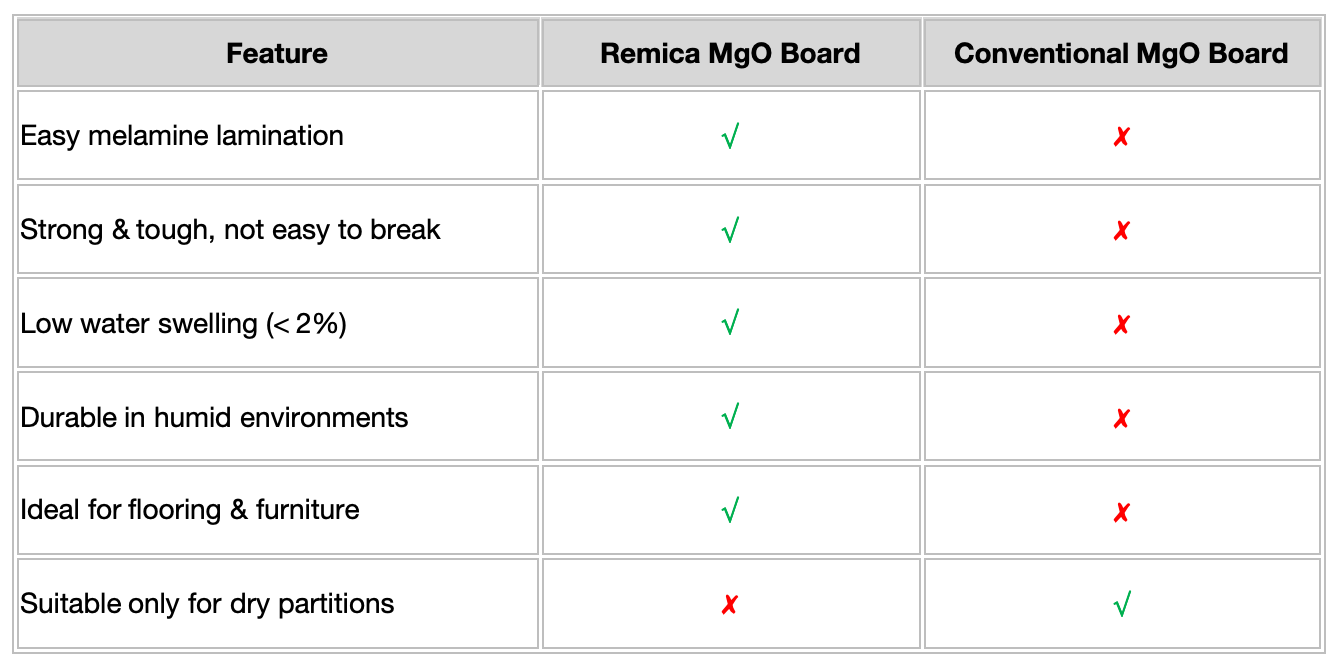
Water absorption swelling ≤ 2%.
Even under severe test conditions (e.g., boiling in 100 °C hot water for 1 hour), an 8 mm thick board shows expansion less than 1.5%.
Thanks to the dry process, the board exhibits excellent dimensional stability and very strong water resistance.
Conventional MgO Board (Wet Process)
Generally has higher water absorption, with reported swelling rates around 4–11% under 75% relative humidity.
Wet-processed MgO boards are more likely to absorb moisture and deform in humid or wet environments.
Durability & Stability
Remica Dry Process: Highly stable in wet–dry cycles, hot water immersion, and freeze–thaw tests. Minimal dimensional change.
Wet Process: May suffer higher mass gain and strength reduction under repeated moisture exposure.
Performance Differences
Surface Lamination
Remica MgO Wood Board: Specially formulated with wood powder in the core. This gives the board a “wood-like” surface structure, making it much easier to directly laminate melamine decorative paper. No additional treatment is required.
Conventional MgO Board: Made purely with mineral compounds or reinforced with fiberglass mesh. The surface is brittle and less compatible with melamine lamination, often requiring extra priming or coating steps.
Mechanical Strength & Toughness
Remica MgO Wood Board: The addition of wood powder improves toughness and impact resistance. The board is strong and durable, less likely to crack or shatter during handling, cutting, or installation.
Conventional MgO Board: While rigid, it tends to be more brittle. Dropping or rough handling can easily cause chipping or breakage, limiting its use in applications that require high durability.
Application Performance
Remica MgO Wood Board: Ideal as a substrate for flooring, furniture panels, and decorative boards, where both strength and lamination compatibility are critical.
Conventional MgO Board: Better suited for general partition walls or ceiling applications, but less competitive in furniture and flooring where surface finishing and toughness are required.
Conclusion: Why Remica MgO wood board?
Download Remica MgO board full introduction by clicking here.
Remica MgO laminated wood board structure & applications


 English
  Russian
  Spanish
  Arabic
  German
  Chinese
  Thai
Thai  Vietnamese
  Italian
  French
  Portuguese
  Turkish
  Korean